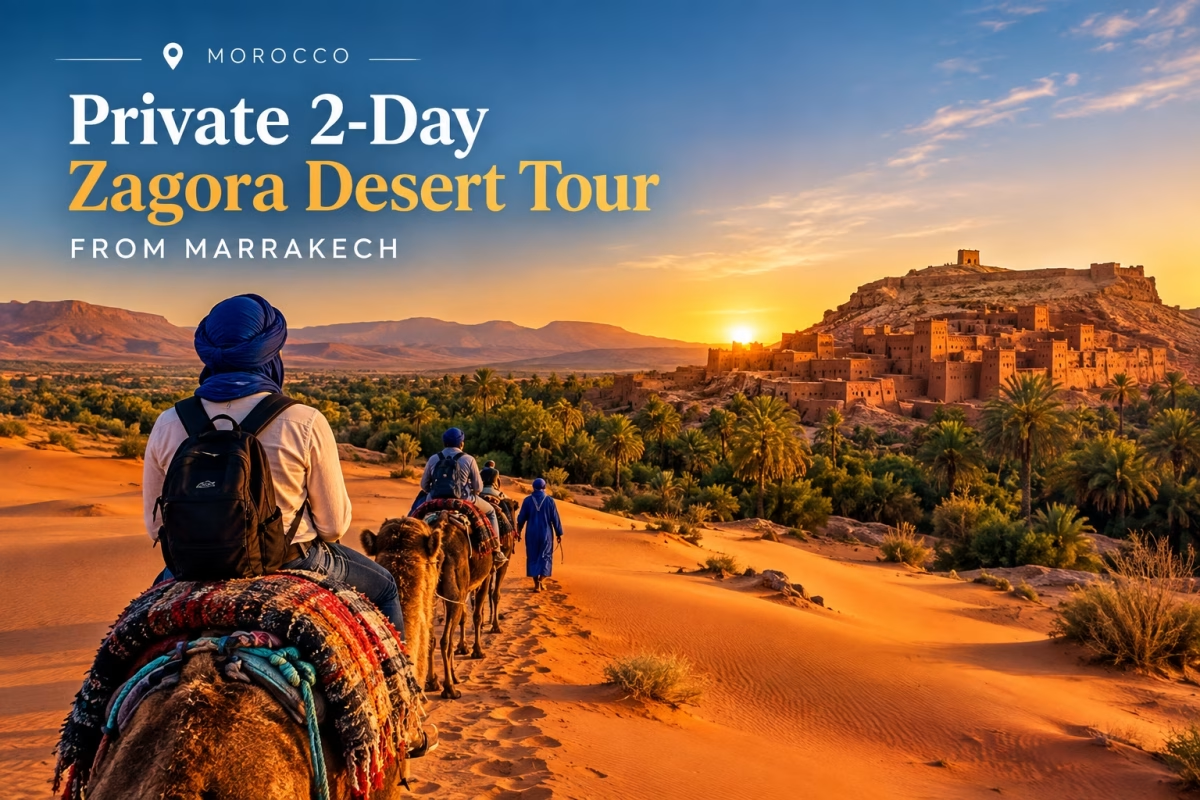
Private 2-Day Zagora Desert Tour from Marrakech: Complete Travel Guide
A Private 2-Day Zagora Desert Tour from Marrakech is designed for travelers who want to experience southern Morocco’s desert landscapes without committing to a longer journey to Merzouga. In two packed days, the route crosses the High Atlas Mountains, visits the historic ksar of Ait Ben Haddou, follows the palm-filled Draa Valley, reaches Zagora, and includes a camel trek and overnight desert camp.
The main advantage is time: Zagora is more practical for a two-day itinerary from Marrakech than Morocco’s larger dune fields around Merzouga. The trade-off is equally important to understand. This is a fast-paced road trip with considerable driving, and the dunes around Zagora are smaller than Erg Chebbi’s towering formations.
This guide explains the route, what to expect from the desert camp and camel trek, how Zagora compares with Merzouga, what to pack, when to travel, and whether a two-day desert tour is the right choice for your Morocco itinerary.
Why Choose a Private 2-Day Zagora Desert Tour from Marrakech?
When comparing tours from Marrakech, travel time is one of the most important considerations. Morocco’s major desert destinations are separated from Marrakech by the High Atlas Mountains and long stretches of road, so reaching the desert and returning within two days requires a carefully planned route.
A 2-day desert tour from Marrakech to Zagora provides a practical option for a short stay. Rather than focusing exclusively on the final destination, the journey combines several distinctive landscapes and cultural stops:
- The High Atlas Mountains and Tizi n’Tichka Pass
- Ait Ben Haddou and its historic earthen architecture
- Ouarzazate and its association with filmmaking
- The palm groves and settlements of the Draa Valley
- A camel trek near Zagora
- Sunset and sunrise in the desert landscape
- An overnight stay at a desert camp
- Traditional music and Moroccan hospitality, depending on the camp program
The private format adds flexibility. Compared with traveling in a larger group, a private vehicle can make it easier to adjust photo stops and travel at a pace suited to couples, families, or small groups. Exact stops and inclusions should always be confirmed with the tour operator before departure.
Is Zagora Really the Sahara?
Zagora is a historic desert gateway in southern Morocco associated with trans-Saharan caravan routes. Its location and caravan heritage create a strong desert atmosphere, but travelers should distinguish the landscapes around Zagora from the much larger dune fields commonly associated with Merzouga and Erg Chebbi.
Zagora is also associated with the well-known “Timbuktu – 52 Days” sign, a reminder of the long caravan journeys historically linked with routes across the Sahara.
For a two-day itinerary, Zagora’s advantage is accessibility from Marrakech. Visitors can experience arid landscapes, camel trekking, a desert camp, broad night skies, and sunrise and sunset without the additional travel required to reach Merzouga.
If towering dunes are the priority, consider allowing more time for a 3-day desert tour from Marrakech to Merzouga or a 4-day desert tour from Marrakech to Merzouga. Zagora is better suited to travelers who prioritize a compact desert journey over the scale of the dunes.
2-Day Zagora Desert Tour Itinerary at a Glance
The route is compact but varied. A typical itinerary follows this general structure, although exact stops and timings can differ by operator, weather, traffic, and road conditions.
Day 1: Marrakech to Zagora
- Depart Marrakech
- Cross the High Atlas Mountains via Tizi n’Tichka
- Visit Ait Ben Haddou
- Continue through or near Ouarzazate
- Travel through the Draa Valley
- Arrive near Zagora
- Take a camel trek toward the desert camp
- Watch sunset and spend the night at camp
Day 2: Zagora to Marrakech
- Wake for desert sunrise
- Have breakfast at camp
- Return from camp by camel or 4×4, depending on arrangements
- Travel north via Ouarzazate
- Cross the High Atlas Mountains
- Return to Marrakech in the evening
This itinerary combines mountains, historic architecture, palm-filled valleys, desert scenery, and an overnight camp in a short period. That variety is its greatest strength, but travelers should also expect substantial road time.
Day 1: Marrakech to Zagora Desert
Crossing the High Atlas Mountains
The journey generally starts early, with the original itinerary indicating a departure at around 8:00 AM. From Marrakech, the road climbs into the High Atlas Mountains and crosses the Tizi n’Tichka Pass at approximately 2,260 meters.

The road winds through steep mountain scenery, valleys, and settlements. Winter conditions can bring snow to higher elevations, while red and ochre slopes define much of the landscape at other times of year.
Photo opportunities appear throughout the crossing, but the best views depend on the direction of the road, stopping points, weather, and light. If photography is important, ask your driver which safe viewpoints are planned rather than relying on a particular side of the vehicle.
Exploring Ait Ben Haddou
After crossing the High Atlas, the route reaches Ait Ben Haddou, a fortified earthen settlement recognized as a UNESCO World Heritage Site. Its clustered buildings, defensive walls, towers, and traditional construction make it one of the most distinctive architectural stops on the journey.

Ait Ben Haddou has also served as a filming location for international productions. Walking through the ksar provides a closer look at the earthen architecture and the defensive design of the settlement.
A local guide can provide additional historical and architectural context. If a guided visit is not included in the tour, clarify arrangements and any additional costs before setting out.
Ouarzazate and Its Film Heritage
The route continues toward Ouarzazate, a city strongly associated with Morocco’s film industry and home to Atlas Film Studios. Its surrounding landscapes and architecture have contributed to its reputation as a major filmmaking destination.
Ouarzazate is also an important crossroads for longer desert journeys. Routes such as a 3-day desert tour from Marrakech to Fes and a 4-day desert tour from Marrakech to Fes use southern Morocco as part of a longer journey toward eastern destinations.
Driving Through the Draa Valley
South of Ouarzazate, the scenery changes dramatically as the road reaches the Draa Valley. Palm groves, cultivated areas, earthen settlements, and arid mountains create one of the strongest visual contrasts of the trip.

The valley has long been connected with settlement, agriculture, and caravan routes through southern Morocco. Date palms line large sections of the oasis, while fortified villages and kasbah-style architecture appear throughout the region.
This scenery makes the Draa Valley one of the highlights of many desert tours from Marrakech, even before travelers reach Zagora.
Camel Trekking Near Zagora
By late afternoon, the itinerary reaches the desert area near Zagora, where the camel portion of the trip begins. The original itinerary indicates a camel trek of roughly 45 to 60 minutes, although exact duration can vary by camp location and tour arrangements.

Camel rides move at a slow pace and can feel unfamiliar if you have never ridden before. Long trousers can reduce friction, while secure, comfortable footwear is more practical than loose sandals. Follow the handler’s instructions when the camel stands up or kneels, as those transitions can feel abrupt.
When timing and weather cooperate, the late-afternoon ride also creates opportunities to photograph warm desert light and camel silhouettes against the horizon.
What to Expect at a Zagora Desert Camp
On reaching camp, guests are commonly welcomed with mint tea. Dinner arrangements depend on the camp and package, but the original itinerary describes a meal that may include:
- Traditional tagine
- Fresh bread
- Moroccan salads
- Seasonal fruit
Some camps also organize local music and drumming after dinner. Once camp activity settles, the darker desert surroundings can provide rewarding conditions for looking at or photographing the night sky, depending on weather and moonlight.
Travelers wanting more than one night in the desert can compare this compact trip with an overnight Merzouga desert and camel trekking experience or two nights in Merzouga with camel trekking. Those alternatives focus more time on the Merzouga desert area.
Day 2: Desert Sunrise and Return to Marrakech
An early start gives you the opportunity to see sunrise over the desert landscape. Morning light creates long shadows and cooler conditions before the day’s journey back across southern Morocco.
After breakfast, the return from camp may be by camel or 4×4 vehicle, depending on the arrangements. You then reconnect with the road toward Ouarzazate and its surrounding landscapes before crossing the High Atlas Mountains again.
The original itinerary gives a typical Marrakech arrival window of approximately 6:00 PM to 7:30 PM. Treat this as an estimate rather than a guarantee, since mountain roads, traffic, stops, and other conditions can affect the return time.
Standard vs Luxury Desert Camps
Camp type can make a substantial difference to overnight comfort, so it is worth confirming exactly what your booking includes. Labels such as “standard” and “luxury” are not necessarily identical from one operator or camp to another.
Standard camps generally emphasize a simpler desert experience and may use shared facilities. Luxury camps may provide additional amenities such as:
- Private ensuite bathrooms
- More comfortable bedding
- Solar-powered lighting
- Hot showers in some camps
Before paying for an upgrade, ask specifically about the sleeping arrangement, bathroom facilities, bedding, shower availability, meals, electricity, charging facilities, and transport to and from camp. Checking the actual inclusions is more useful than relying on the camp category alone.
Zagora vs Merzouga: Which Desert Trip Should You Choose?
The main decision is straightforward: choose Zagora when time is limited, and consider Merzouga when larger dunes and a longer desert experience are more important.
| Consideration | Zagora | Merzouga |
|---|---|---|
| Best suited to | Short Marrakech itineraries | Travelers with more time |
| Desert scenery | Smaller dunes and arid landscapes | Larger dune fields around Erg Chebbi |
| Typical trip style in this guide | Compact two-day road trip | Longer desert itinerary |
| Main advantage | More practical within two days | Greater focus on large dunes and desert immersion |
For a longer Marrakech departure, options include a 3-day Marrakech to Merzouga desert tour, a 4-day Marrakech to Merzouga desert tour, or a 6-day Marrakech to Merzouga desert tour.
Merzouga is associated with the larger dunes travelers often picture when imagining a classic Moroccan desert landscape. By comparison, the 2-day Marrakech to Zagora desert tour is primarily about experiencing the diversity of southern Morocco within a shorter timeframe.
Official destination information about the wider Errachidia, Midelt and Merzouga region can also help travelers understand how the eastern desert differs from the Zagora route.
Longer Desert Routes From Fes
Travelers beginning in Fes have different routing options and do not necessarily need to return through Marrakech. Depending on the overall itinerary, choices include:
- 2-day desert tour from Fes to Merzouga
- 3-day desert tour from Fes to Merzouga
- 3-day desert tour from Fes to Marrakech
- 4-day desert tour from Fes to Marrakech
- 5-day desert tour from Fes to Marrakech
- 6-day desert tour from Fes to Marrakech
Travelers researching broader tours from Fes can compare these routes according to their arrival city, available days, and onward destination.
Desert Tours From Casablanca, Tangier, Agadir and Rabat
A desert trip does not have to begin in Marrakech. Longer routes can connect Morocco’s major arrival cities with southern and eastern destinations, which may be more convenient for travelers building a multi-city itinerary.
From Casablanca
- 5-day desert tour from Casablanca
- 6-day desert tour from Casablanca
- 7-day desert tour from Casablanca
- 8-day desert tour from Casablanca
- 9-day desert tour from Casablanca
- 10-day desert tour from Casablanca
Visitors arriving on Morocco’s Atlantic coast can also review broader tours from Casablanca before deciding how to connect the city with the desert.
From Tangier
- 4-day desert tour from Tangier
- 5-day desert tour from Tangier
- 6-day desert tour from Tangier
- 7-day desert tour from Tangier
- 8-day desert tour from Tangier
- 9-day desert tour from Tangier
If northern Morocco is your starting point, broader tours from Tangier provide another way to structure a longer cross-country journey.
From Agadir
Travelers starting on the southern Atlantic coast can consider a 6-day tour from Agadir to the desert via Marrakech. Other tours from Agadir may suit travelers who want to integrate the coast with an inland itinerary.
From Rabat
A 5-day desert tour from Rabat to Merzouga and Marrakech provides a multi-city alternative. Travelers can also compare broader tours from Rabat according to their available time.
Best Time for a Zagora Desert Tour
Spring and autumn generally offer the most comfortable conditions described for this itinerary. Summer can become extremely hot, with the original guide noting temperatures that may exceed 45°C, while winter desert nights can approach freezing.
Whatever the season, temperature differences between daytime and nighttime make adaptable clothing important. Basic precautions include:
- Pack layers for changing temperatures
- Carry and drink sufficient water
- Use sunscreen and other sun protection
- Bring a warmer outer layer for the evening and early morning
Conditions can change quickly after sunset, so packing only for daytime temperatures can leave you underprepared for camp.
What to Pack for a 2-Day Zagora Desert Tour
You will repeatedly move between a vehicle, sightseeing stops, a camel ride, and camp, so light, practical luggage is easier to manage than a large suitcase.
Clothing
- Breathable clothing for daytime
- Long trousers for the camel ride
- A warm jacket or extra layer for evening and morning
- Comfortable walking shoes
- A scarf for sun, wind, or dust
Personal Essentials
- Sunglasses
- Sunscreen
- Lip balm
- Personal medication
- Drinking water as required for the journey
Photography Equipment
- Camera or phone
- Extra batteries or a suitable power source
- Tripod if you plan to photograph the night sky
Keep valuables, medication, and important personal items in a small bag that remains accessible rather than buried inside larger luggage.
Safety and Practical Advice
The route involves winding mountain roads, long periods in a vehicle, outdoor activities, and changing temperatures. Choosing an experienced driver and following local instructions are important parts of a comfortable journey.
- Tell the operator or driver about relevant medical concerns.
- Keep necessary medication with you.
- Follow the camel handler’s instructions when mounting and dismounting.
- Use sun protection and stay hydrated.
- Wear appropriate footwear at sightseeing stops and camp.
- Respect local customs and ask before photographing people.
- Confirm camp facilities and tour inclusions before departure.
Solo travelers, including women traveling alone, may value the structure and privacy of a private tour. Personal comfort and security needs vary, however, so review the itinerary, accommodation arrangements, transport, and operator details before booking.
Desert Photography Tips
The route offers photography opportunities from the High Atlas to the desert camp. Desert light is often most visually interesting close to sunrise and sunset, when lower-angle sunlight emphasizes shapes and textures.
- Use the warmer light around sunrise and sunset for landscape photographs.
- Try silhouettes when camels or people are positioned against a bright horizon.
- Look for shadows and texture across dunes and arid terrain.
- Use a tripod for longer night exposures when conditions allow.
- Protect cameras and lenses from dust and sand.
- Ask permission before photographing local residents.
Dark surroundings can support night-sky photography, but results depend on cloud cover, moonlight, camp lighting, camera equipment, and shooting technique.
Cultural Etiquette in Amazigh and Berber Communities
Many travelers know Morocco’s Indigenous Amazigh communities by the widely used term “Berber.” When visiting villages, shops, roadside stops, or camps, simple respectful behavior contributes to more positive interactions.
- Ask before taking close photographs of people.
- Choose clothing that is respectful of local norms.
- Receive hospitality, such as mint tea, courteously.
- Buy from local artisans when their work genuinely interests you.
- Remember that villages and working communities are homes, not staged attractions.
Pros and Cons of a 2-Day Zagora Desert Tour
Advantages
- Time-efficient: It provides a desert-oriented experience within a two-day Marrakech itinerary.
- Varied scenery: The journey combines mountains, valleys, historic settlements, oases, and arid landscapes.
- Private flexibility: Private transport can provide more control over stops and pacing.
- Overnight experience: The itinerary includes a desert camp, camel trekking, sunset, and sunrise.
Disadvantages
- Long driving hours: Much of the two-day itinerary is spent traveling between Marrakech and Zagora.
- Smaller dunes: Zagora does not provide the same scale of dunes associated with Merzouga.
- Fast pace: Major stops must fit into a compact itinerary, leaving limited time at each location.
Understanding those trade-offs before booking is essential. Zagora is most rewarding when approached as a varied southern Morocco road trip with a desert overnight rather than as a substitute for several days among Merzouga’s larger dunes.
Who Is the 2-Day Zagora Tour Best For?
A Private 2-Day Zagora Desert Tour from Marrakech is particularly suited to:
- Travelers with limited time in Marrakech
- Couples who prefer a private itinerary
- Families and small private groups
- First-time visitors planning a wider Morocco trip
- Photographers interested in varied landscapes
- Travelers comfortable with substantial driving
Anyone wanting more time among larger desert dunes should consider extending the itinerary. A 6-day desert tour from Marrakech to Merzouga, for example, allows a different pace and a greater emphasis on the eastern desert region.
Frequently Asked Questions
Is a 2-day Zagora desert tour from Marrakech worth it?
It can be a good choice if you have only two days and want to combine the High Atlas Mountains, Ait Ben Haddou, the Draa Valley, camel trekking, and an overnight desert camp. The main compromise is the amount of driving and the smaller scale of Zagora’s dunes compared with Merzouga.
Can you visit the desert from Marrakech in two days?
Yes. Zagora is a practical destination for a two-day desert-oriented trip from Marrakech. The itinerary is fast-paced because it includes the outward journey, sightseeing stops, an overnight camp, and the return drive.
How long is the camel ride in Zagora?
The itinerary described here indicates approximately 45 to 60 minutes of camel trekking. Exact duration can depend on the camp location and arrangements, so confirm it with the operator when booking.
Is Zagora or Merzouga better?
Neither is universally better. Zagora is more practical for a short two-day Marrakech itinerary, while Merzouga is the stronger option for travelers prioritizing larger dunes and a longer desert experience.
What should I wear for camel trekking?
Long trousers and comfortable, secure footwear are practical for a camel ride. A scarf, sun protection, and layers are also useful because desert temperatures and conditions can change between day and night.
What is the difference between standard and luxury desert camps?
Standard camps generally offer simpler accommodation and may have shared facilities. Luxury camps may provide ensuite bathrooms, upgraded bedding, solar lighting, and sometimes hot showers. Facilities vary, so confirm the exact inclusions before booking.
When is the best time to take a Zagora desert tour?
Spring and autumn generally provide the most comfortable conditions described for this journey. Summer can be extremely hot, while winter nights can become very cold, making layers important throughout the year.
Is a Private 2-Day Zagora Desert Tour From Marrakech Right for You?
The strongest reason to choose Zagora is not that it replicates Merzouga in less time, but that it makes a varied southern Morocco journey possible within a compact itinerary. From the High Atlas and Ait Ben Haddou to the Draa Valley, camel trek, desert camp, sunset, and sunrise, the route delivers significant changes in scenery over two days.
The trade-off is pace. There is considerable driving, sightseeing time is limited, and the desert formations around Zagora are smaller than the major dunes farther east. Travelers who understand those differences are better positioned to choose the itinerary that matches their expectations.
If your schedule allows only 48 hours away from Marrakech, Zagora provides a practical introduction to southern Morocco’s desert landscapes. If larger dunes and deeper desert immersion matter more than speed, allocate additional days to a Merzouga route instead.